

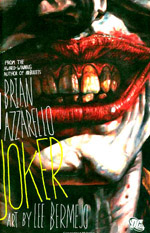
Joker - Brian Azzarello and Lee Bermejo
Written by Brian Azzarello
Art by Lee Bermejo and Mick Gray
Cover by Lee Bermejo
Colors by Patricia Mulvihill
Published by DC Comics ; 128 pages
Amazon.com would like to sell you a copy

Batman Shirt Modern Logo – Amazon
Pills and Psychos
Petty criminal Jonny Frost is out of prison for his fifth time. He's got a wife who is working hard to legally become his ex-wife, kids he has no interest in, and when his local gang of crooks learn Joker is inexplicably being released from Arkham, Frost volunteers to pick him up.
Azzarello's story is a well-done Batman comic book novel (though Bats only really appears in the last few pages of the book. On the other hand, he is always on Joker's mind in some way so there isn't any moment that we do not know that Gotham is where Batman lives and a place where Joker can only temporarily work his magic).
Joker takes an instant liking to Frost. Jonny is naive, amiable, malleable, slightly-innocent somehow, and he has what Joker needs - a car. Soon he is Joker's driver and sidekick, followed by Harley Quinn, who is working at a strip-bar when she rejoins Joker as his demented other sidekick, handing over drugs and acting as a kind of mother-confessor in the wee hours.
Azzarello uses the character of Jonny Frost as a looking glass into the private realm of Joker's unhinged world, and what we get is a pill-fueled crime lord who becomes increasingly vicious and frenzied as his badly articulated effort to rule all of Gothams underworld goes off the rails. At least, ruling seems to be the Joker's intentions, but as the body count mounts it appears such a plan is simply an excuse. The Joker's real goal is to get either God's attention, or just Batmans... in fact Joker seems a bit confused about the two figures, they overlap in his mind and play some part in his personal crazy quest.
Killer Croc's Evolution
Killer Croc in Azzarello's 2004 "Broken City" had previously been a more evolved version of the usual lizard-like (and Marvel comics-like) killer from other Batman comics. Here Azzarello has evolved Croc even further, and he is now essentially just a very large criminal with a strange skin ailment and the foresight to see what's really going on around him as he acts as Joker's 'muscle'. Croc also defines Frost's future: it will end with Jonny gurgling in his own blood. We sense that Croc has seen this all before and can predict the Joker's pattern effortlessly. Frost, on the other hand, was too preoccupied with the quickly vanishing glamour of working with a famous criminal, satisfaction that quickly gave way to just playing for survival, Joker's moods swinging from affection to a vindictive, murdering rage in the space of a panel or two.
Joker; his phobias and friends
Azzarello's Joker has a number of psychological problems besides just a desire to see a lot of blood spattered everywhere. He has a raging inferiority complex, a desire for self-destruction wound up with doses of megalomania and feelings of being wrongly persecuted.
When Azzarello's Joker reveals he doesn't eat food, he just lives on pills, a twisted inversion of Elvis, Michael Jackson and every other celebrity who succumbed to chemical living comes to mind. Is the Joker an unintentional glam icon? In keeping with the Joker's 'look' from the Chris Nolan Batman movie, Joker has also had some serious facial surgery performed, with horrendous scars enhancing his smiling visage.
 And this is where the superhero universe intrudes the most into Azzarello's story. None of these characters care about Joker's amazing looks. No one asks, and few remark on it. Joker tells Croc how he likes to see him because it makes him feel handsome, but since Bermejo draws Croc as essentially a generic looking (though a bit scaly) muscle-bound gangsta from the 'hood, the remark doesn't make a lot of sense. In a "real world" there would be a lot of commotion over Joker's visuals, but there's not much here among this cast of characters (however, in the tale people get quite nervous when confronted by the Joker, but this seems to be all about the man's deserved reputation for random killing versus the milky-white death grin he is sporting).
(Regarding visuals: Azzarello has Joker verbally dwell on Batman's look for a bit, a combination of analysis, ridicule and an expression of Joker's twisted affection for the Caped Crusader.)
Though the silent Harleen Quinzel seems exempt (like Croc), everyone else in the tale is in a tense position where they might be on the receiving end of Joker's next burst of crazed excess. But as demented as the Joker is, he is also a standard issue control-freak/sadist with a demand to approve/not approve of the behaviour of the people close to him. Frost's anxiety grows as he starts tripping over those shifting lines of conduct that Joker requires, a set of rules that he finds harder and harder to understand as he sees other victims randomly dispatched by an unpredictible caprice in the Joker's mind.
Abusive and controlling, Joker is a father figure that Frost is attracted to but then later can only fear. Quinzel seems to know how this all works, she says nothing whatsoever throughout the story but otherwise seems to anticipate every move. Croc's business attitude seems to shield him, and he makes no special editorial statements (aside from his warning to Frost). Penguin appears briefly, but Joker's contempt and Penguin's inability to play the behaviour game correctly almost gets him killed.
Gotham's Status Quo
There is 'noir' twaddle in the tale, the hiccups of crime writing in which Gotham is apparently being victimized in an almost supernatural way by an inscrutable God. That is, for Azzarello, Gotham is a terrible place without any redemption possible. In fact it was probably built from the same disease that infects Joker. In this tale, Azzarello's Jonny Frost thinks this line of thought even further: Joker himself is a disease.
Azzarello hasn't built up the oppressive claustrophobia of an urban noir, that feeling that the entire city (and maybe the whole universe) is in cahoots against the main characters. Instead, all of the random and malevance is centered around the actions of our famous crazed clown, the city a distant background for the activity.
Azzarello's other criminal characters are organized, grossly refined, completely dedicated to a status quo where corruption works hand in hand (and relatively peacefully) with the rest of the middle class around it. In the end, the Joker is a whirling tazmanian devil creating chaos and spilling blood, but just one unique fellow in a big city.
The ex-con Jonny Frost narrates his personal criminal career highlight reel with his joining the Joker's ranks, and then the swift plummet to well-deserved paranoia and endless fear of the next moment. Should Frost feel Gotham City and the Joker are marshalled equally against his survival (and sanity)? But it is clear only his close proximity to the Joker that is really posing a threat.
Azzarello doesn't make Gotham come alive as a third character having its own actions and intentions, instead all of the very detailed architectural drawing and text produces mere travelogue. The characters are alive and interesting, the city is background.
Lee Bermejo and Mick Gray Artwork, Patricia Mulvihill Colors
Lee Bermejo's artwork is effective and makes for a true professional superhero comic. Mick Gray assists with nicely drawn buildings and bridges. A reliance on photo reference haunts the look of this book, but the finishing effects are interesting and remind me of Italian comic books, that is where a series of frames are drawn in a basic ink on paper style, but certain panels are embellished into small paintings. This seems to emphasize that a particular panel is important for the reader to notice, or just to show that the artist can really create a beautifully detailed image, but there's not enough time to do the whole book that way.
The colors by Patricia Mulvihill keep the book in a seedy, shadow-filled nightmare mode of dank and dark criminality. Although there are glimpses of the city as if it just might be any other American city with its good and bad sides, what we really see are endless visions of a bad place with a very bad man running amok.
The Long Shadow of Heath Ledger
A step removed from the usual Batman graphic novels, Azzarello's JOKER is built somewhat along the lines of the Heath Ledger Joker from the Dark Knight movie, although I have read that Azzarello was already in progress on this tale prior to the Dark Knight movie release. Either way it is in keeping with the sick-fiend dreamed up by Jerry Robinson back in Batman #1 from 1940, versus the cartoony character that developed over the decades within the standard month-to-month fare of DC Comics.
Summary: DK Joker vs Azzarello Joker
In the Nolan Dark Knight film, the Heath Ledger Joker character is dedicated to exposing the hypocrisy and double-dealing of Gotham's citizens, with a big dose of self-justification going into the project. As with the start scene from that film where Joker kills off his henchmen one by one, the dangerous and unpredictable personality of the Joker is given center-stage.
Azzarello takes a more nuanced approach, since his Joker is more common pillhead blown up larger than life by way of makeup (or surgery?) and a taste for ultra-violence, bloodletting, coupled with hints of supernatural foreboding.
There's more nuts-and-bolts of running a gang in Azzarello's tale, and though the Ledger Joker has obviously been stamped into the visuals of this book, Azzarello's Joker is still a deeper, more complex step apart from the Hollywood creation.
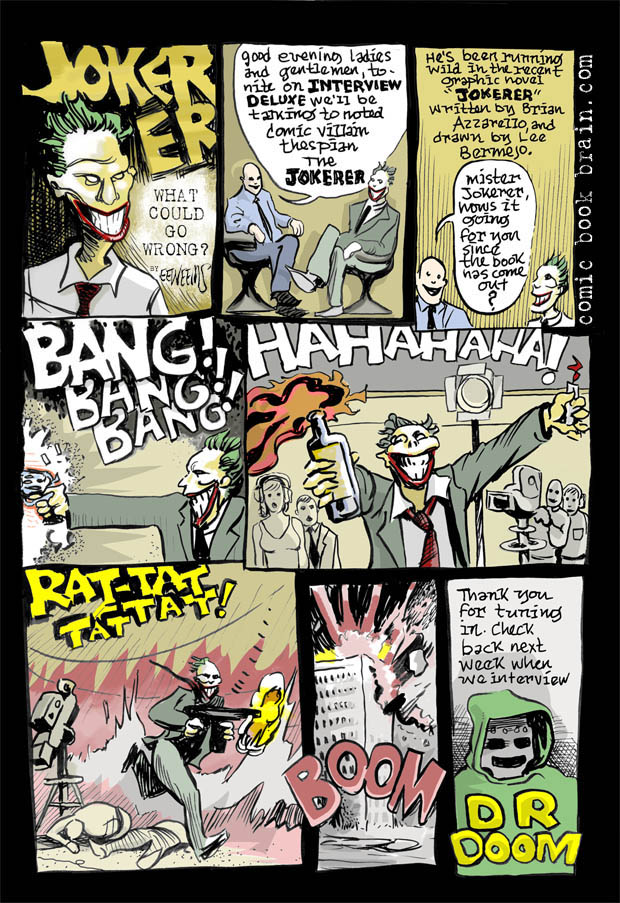
Directly related: The Azzarello Joker gets interviewed!
Related: More Reviews!
Detective Comics #831 - Reforming Harley Quinn June 2007
Brave and the Bold #131, DC Comics December 1976 by Bob Haney with art by Jim Aparo
Review Adventure Comics #423, featuring Supergirl DC Comics Sept 1972
Review: Knight Terrors First Blood #1 DC Comics July 2023
Hell is a Squared Circle by Chris Condon and Francesco Biagini September 2022 AfterShock Comics
Review: Weird Mystery #4, Jan-Feb 1973
The Secret Life of Catwoman, Batman #62, Dec 1950–Jan 1951
The Origin of the Superman-Batman Team - review of World's Finest #94, May-June 1958, art by Dick Sprang
The Spirit Reborn - Review of The Spirit #1, Feb 2007 By Darwyn Cooke
Superman Confidential #1, January 2007 By Darwyn Cooke and Tim Sale
Richard Corben's Edgar Allan Poe – Poe's Haunt of Horror #1, 2006
Bloodstar - 1975 - Richard Corben
House on the Borderland 2000 - by Richard Corben
Review of the Joker Graphic Novel - Brian Azzarello and Lee Bermejo 2003
Review Harley Quinn #55, Feb 2019 - "We'll All Be Home for Christmas"
Edgar Allen Poe Haunt of Horror #1 2006 - by Richard Corben
More Joker
The Joker Movie Log
You will see Amazon links on this web site because I am an Amazon affiliate. I earn from qualifying purchases.

Original Page Oct 2013 | Updated March 2021